


| For More Information |
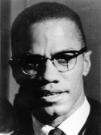
| Malcolm X Malcolm Little, later known as Malcolm X, was one of the most controversial and well- known figures in the American civil rights movement during the 1950’s and 1960’s. His eloquent speaking ability, charismatic personality, and vocal criticism of the U.S. political system caused suspicion among the white community as well as extensive media interest in his rather “militant” theories regarding ways of changing society for blacks in America. His numerous childhood confrontations with racism shaped his attitudes regarding the white community and he is often referred to as the “Father of the Black Power Movement”. His assassination at the age of thirty-nine shocked both the black and white populations in the U.S. and had a significant impact on the continued efforts made by activists in attempting to obtain equal rights for blacks. Malcolm was born on May 19, 1925, in Omaha, Nebraska. He spent much of his youth living in institutions and foster homes after his father was killed in a “suspicious” streetcar accident and his mother was declared legally insane and committed to the State Mental Hospital in Kalamazoo, Michigan where she remained for the next 26 years. Among the numerous racist incidents Malcolm endured during his childhood, was the intentional burning of his home in Lansing, Michigan by members of the KKK. After losing both of his parents, Malcolm moved to Boston to live with his half-sister, Mrs. Della Collins and began a series of odd jobs that included shining shoes, washing dishes and intermittently working for the New Haven Railroad. He became increasingly involved in illegal underworld activities such as selling drugs, bootlegging, burglary, pimping, and gambling, and was eventually sentenced to numerous prison terms. During a 10- year sentence, his life was “transformed” by a series of events that influenced his life and led him to become one of the most influential leaders in the black civil rights movement. While in prison, Malcolm immersed himself in an intensive “self-study” program, which focused primarily on reading the Bible and the Koran. He became a devoted follower of Elijah Muhammad’s “Nation of Islam (NOI) and began to actively participate in black Muslim group activities. After he was released from prison he continued his studies of the NOI and changed his name to “Malcolm X. He was ordained as a minister and rose to a high level of power in the NOI while serving at mosques in Detroit, Philadelphia, and Harlem. His philosophy called for blacks to “sit and wait - that white man will destroy himself” was supported by a large population of the black communities in which he served and after undertaking a grueling schedule of public speaking engagements, his influence began to spread throughout the country. As his popularity as a speaker advocating civil rights for blacks expanded, he began to antagonize the white community by referring to them as “ blue-eyed devils.” He vocally criticized the U.S. government and felt that even somewhat violent tactics were necessary in order to change the social and economic status of blacks. His methodology was in complete opposition to the more “peaceful” philosophy of Martin Luther King. As his influence increased, he began to openly criticize the philosophies of other black leaders who supported “integration” into white society rather than the creation of institutions for blacks only and proposed that blacks should openly defend themselves from racist violence. He occasionally supported boycotts and protest gatherings. He further alienated the white community by rigidly adhering to the NOI beliefs that “men must lead, women must follow - the man’s domain is the world, the woman’s is the home”. Malcolm openly disagreed with the NOI’s policy of non- participation in politics and believed that “mobilization” was necessary for change. He formed alliances with black, white, and Puerto Rican organizers and began to develop a “Pan-Africanist – Third World” political perspective during a time when “anticolonial wars and decolonization” were issues on the forefront of world concern. Animosity developed between Malcolm and Muhammad over “family” issues as well as political differences. When Malcolm became aware that he was perceived as being a “threat” to Muhammad’s position of power and that he might be in danger of being assassinated for failing to adhere to the long-held ideologies of the NOI. He quickly resigned as a leader of the NOI and apologized for his behavior. Despite his attempts to temper his philosophies and work more amiably with other civil rights leaders, the FBI and other government agencies began to sabotage his efforts and his fear of assassination increased. In response to the threats to his life, Malcolm formed the Muslim Mosque, Inc., devoted to cooperation with other civil right’s leaders and working within the existing political system. He also began an overseas tour, visiting several African and Arab nations after which, he changed attitude toward the white community, proclaiming that they were no longer “devils” in his opinion. In 1964, shortly before his death, he announced the formation of the Organization of Afro-American Unity (OAAU) founded on the principle that members and supporters should do “whatever is necessary to bring the Negro struggle from the level of civil rights to the level of human rights.” The OAAU advocated independent black institutions along with black participation in the U.S. political system. Malcolm X was assassinated while speaking to a large audience of OAAU supporters at the Audubon Ballroom in New York on February 21, 1964 by gunmen affiliated with the NOI. Over 1500 people attended his funeral. Muhammad, though believed to have been implicated in his death, denied any allegations of his personal involvement. His death was a shock to America and his life, an inspiration to both black and white communities. |
Return To Top