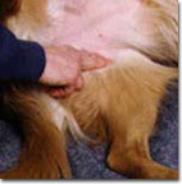
| How to take a pulse There are several areas on the dog's body where you may be able to feel the pulse. A pulse occurs with every heart beat. Sometimes, you can just place your hands low on your dog's chest, near the elbow joint, and feel the heart beats. You can count how many beats you feel in 15 seconds and then multiply it be 4. That will give you the pulse. A second place to find the pulse is high on the inner side of the thigh. You will be feeling for the femoral artery. Place two fingers on the middle of the thigh near where the leg joins the body. What you feel is the 'femoral pulse.' The femoral pulse can be very difficult to feel in cats. It is always best to use your fingers to feel the pulse. If you use your thumb, and press too hard, what you feel will actually be your own pulse. The normal pulse for a dog ranges from 70 to 180 beats per minute. In general, the larger the dog, the slower the pulse. Puppies generally have a fast pulse, up to 220 beats per minute. Cats usually have a pulse of 120-240 beats per minute. The pulse of a dog is not always steady. Sometimes, the rate changes as the dog breathes in and out. The pulse will be faster on inspiration and slower on expiration. This is normal and is called sinus arrhythmia. Veterinary & Aquatic Services Department, Drs. Foster & Smith, Inc |