Whole Dog Journal's 2011 Canned Dog Food Review
Features
November 2011 Issue
By Nancy Kerns
High-quality wet dog foods – canned or pouched – are healthier than
dry dog foods.
Wet dog food is much more “natural” for dogs to eat than dry kibble.
Its moisture content is closer to that of meats, eggs, fruits, and
vegetables – the sort of things that canines have eaten for the tens
of thousands of years before commercial dog foods were invented.
Wet foods usually contain more animal protein – the optimum base
of a carnivore’s diet – than even very high-quality dry foods. Even
the varieties that are formulated with grain – not at all what dogs
have eaten as they evolved – contain far less grain than dry foods.
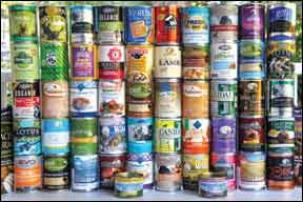
Here’s just a sampling of the top-quality wet dog foods that appear
on our “approved” foods list. They range from high protein and
super-high fat products to more moderately formulated foods.
Pound for pound, wet dog food is also more expensive to feed
(especially large dogs) than dry foods. That’s because, with its high
moisture content, the food is less “energy dense” than dry foods;
you have to feed a larger volume of it to give your dog the calories
and nutrients he needs. All that moisture is expensive to package
and ship.
But the benefits of wet food are many. It’s therapeutic for dogs with
kidney ailments, or any disorder that worsens if a dog gets
dehydrated. Wet foods are generally far more palatable than dry
foods, which can be a literal lifesaver when feeding very thin, sick,
or picky dogs. Most dogs digest high-quality wet foods with fewer
problems (gas, vomiting, and diarrhea) than dry foods. Wet foods
also tend to be far less adulterated with synthetic ingredients than
dry foods; artificial colors and flavors are rare in wet foods. And
preservatives are not added to canned or pouched foods, since the
oxygen-free packaging maintains their freshness. Even without
preservatives, wet foods retain their nutrient value far longer than
dry foods – two years or more.
WDJ’s Selection Criteria
Because of all of these benefits, some holistic veterinarians are of
the opinion that even a lower-quality wet food is healthier than good-
quality dry foods.
We won’t go that far, because we like to see high-quality ingredients
used in any food that’s fed to our canine companions. Not because
we like to imagine that’s what we’d like to eat – the “humanization”
marketing ploy – but because we know that diets comprised of a
variety of locally sourced, fresh, unprocessed or lightly processed,
unadulterated “real food” ingredients are healthiest for any living
organism.
How do we determine whether a wet food contains these high-
quality ingredients? There are two places on a product label we pay
attention to: the ingredients panel and the “guaranteed analysis.”
These sections of the label are required by law and tend to be
subject to closer review and regulation by state feed control
officials than the rest of the package.
We pay no attention to the pictures of the sort of ingredients that
are purportedly in the food; they are almost never included in the
form depicted on the label.
When looking at the ingredients list, we look for the following (these
things are good):
■WHOLE MEAT, FISH, OR POULTRY AS THE FIRST INGREDIENT. This
means that by weight, there is more of this ingredient than anything
else in the food. Wet foods are generally around 78 percent to 82
percent moisture.
There are some good wet foods with water (or broth) first on our
“approved foods” list (starting on page 6), but since fresh meat is so
high in moisture, most top-notch foods feature an animal protein
(fresh meat) first on the list, and water or broth (required for
processing) in the second or third position. The point is to look for
products that contain as much meat as possible.
There has been a resurgence of popularity of complete and
balanced wet foods that contain nothing but meat, water, and a
vitamin/mineral supplement; many of these are labeled with a “95%
meat” claim. Remember: while some dogs benefit from the inclusion
of some carbohydrates in their diets, dogs have no dietary
requirement for carbohydrates! They can thrive on diets that contain
only protein and fat.
■IF GRAINS OR VEGATABLES ARE USED, WE LOOK FOR THE USE OF
WHOLE GRAINS AND VEGATABLES. This means we prefer foods that
contain “rice” rather than rice flour, rice bran, brewer’s rice, etc.
Also, if grains are used in a wet product, we don’t want to see a lot
of them! Even a product with an animal protein first on its
ingredients list may contain more grain than meat if it has several
grains or grain “fragments” on the label, too.
■THE WORDS “COMPLETE AND BALANCED” SHOULD APPEAR ON THE
LABEL. Some manufacturers produce a few wet food products that
are meant for “supplemental or intermittent” use only. These
products do not meet the specifications for a “complete and
balanced diet” as defined by the model regulations developed by
the Association of American Feed Control Officials (AAFCO) and
adopted by each state. While these “supplemental” foods may be
useful as part of a varied diet, they can’t be relied on to provide all
the nutrients your dog needs.
There are also a number of things we look out for – attributes that
would cause us to reject a wet food product (these things are bad):
■PROTEINS OR FATS THAT ARE NOT IDENTIFIED BY SPECIES. “Animal
fat” and “meat proteins” are euphemisms for low-quality, ingredients
of uncertain origin.
■MEAT BY-PRODUCTS OR POULTRY BY-PRODUCTS. There is a wide
range in the quality and type of by-products that are available to pet
food producers. And there is no way for the average dog owner (or
anyone else) to find out, beyond a shadow of a doubt, whether the
by-products used are kept clean, chilled, and used fresh within a day
or two of slaughter (as some companies have told us), or are
comprised of ingredients that were literally swept off a floor,
dumped down the floor drains at the processing plant, and kept for
hours or days on unrefrigerated loading docks and trucks.
In recent years, we’ve learned that there is far more variation than
we knew in the quality of even named, “whole” meats used in pet
foods – the ingredients we’ve described for years as ideal. We were
under the impression that whole, named meats were far too
expensive to be handled in anything less than a similar fashion to
meats meant for human consumption (the legal description is
“edible”). We were wrong; we learned this when we had a chance to
tour a raw ingredient (meat) plant. We’ll discuss this more in our
review of dry foods (in our February 2012 issue). But in the
meantime, all we can say is that the whole, named meats tend to be
of higher quality and are more likely be maintained in a clean, chilled
state prior to processing.
■WHEAT GLUTEN. Wet foods often contain some sort of thickener or
binder. Various types of “gum” (such as guar gum, from the seed of
the guar plant, and carrageenan gum, from seaweed) are common
thickeners. Whole grains, potatoes, and sweet potatoes also can be
used to thicken wet food. But wheat gluten (and some other glutens)
are generally only used in wet foods to hold together artificially
formed “chunks” meant to resemble chunks of meat – you know,
those perfect cubes of meaty mush found in low-cost dog foods?
If chunks of meat are present in a wet dog food, they should be
actual chunks of meat.
■SUGAR OR OTHER SWEETENERS. A food that contains quality meats
shouldn’t need additional palatants to entice dogs.
Artificial Colors, Flavors, or Added Preservatives. Fortunately, these
are rare in wet foods!
Other Ingredients
Some ominous-sounding chemicals in a dog food turn out to be a
source of a needed vitamin or mineral. Generally, all the vitamins
and minerals on a good label are grouped together at the end of the
ingredients list. If an ingredient appears after the vitamins and
minerals, it’s just “window dressing” – present in the food in a
completely insignificant amount.
What about products that contain a long, long list of vegetables and
herbs and nutraceuticals? They make a food sound so appealing!
Just keep in mind that the more of all this stuff there is in a food, the
less room there is for meat – the main reason to feed a wet food.
Let’s Talk About Manufacturing Sites
Since the infamous recalls of 2007, we have required any pet food
company that wanted its products considered for our approval to
disclose their manufacturing sites. Having this information can
vastly reduce the panic and uncertainty a dog owner may
experience upon hearing of a pet food recall stemming from a
certain pet food manufacturing facility; you would know immediately
whether your dog’s food was involved or not.
Not all pet food companies will disclose this information, however.
Many fear that if any product made at that plant is recalled, their own
foods will be “brushed” with the same tar reserved for the recalled
products, even if their ingredients are procured and stored
separately, and the production lines are well cleaned between their
own manufacturing runs and those for other companies’ products.
These are valid concerns. There are pet owners who, since the 2007
recalls of melamine-contaminated foods, have refused to buy
anything that came out of a Menu plant (that’s the company that
manufactured most – not all – of the recalled foods). (Note: those
plants are now owned and operated by Simmons Pet Food, North
America’s largest wet pet food private-label and contract
manufacturer. Some of 2007’s recalled foods were manufactured at
American Nutrition Inc.)
We’ve heard all sorts of reports of alleged misconduct at Evanger’s
Dog & Cat Food Company. We’re also aware of a serious recall of
foods made by Merrick Pet Care (in 2004).
You’ll notice that these three manufacturers (with 7 facilities among
them) are responsible for making most of the products on our
approved foods list; they are also responsible for making almost all
of the high-quality wet pet food in this country. The fact is, there are
fewer than a dozen “contract manufacturers” (also known as co-
packers) in this whole country that manufacture wet pet food for
companies that don’t own and operate their own plants. (All the
corporate giants have their own plants.)
No matter where a product is made, preventing the production of a
product that will cause a recall requires the procurement and
management of top-quality ingredients, good manufacturing
practices, and scrupulous oversight and auditing of the
manufacturing process. It’s far more effective to ask a pet food
company about what it does to accomplish those tasks than it is to
blacklist every product made in any facility that ever had a recalled
food. With the exception of the brand-new plant launched by Lotus
Pet Foods this year, we’re not sure there are any other plants with a
perfectly clean record.
Finally, speaking of Lotus, we recently toured its facility and
observed the production of a batch of its food. An article describing
exactly how wet pet food is made (and photos of the process)
appears on the WDJ website.
The List
Below is our list of “approved wet foods” for 2011. All of these
products have met our selection criteria and the company whose
name is on the label has disclosed its manufacturer/s. There are
probably more products that both meet our criteria (as described
above) and whose makers would answer your questions about their
manufacturers. Rest assured that any food that you find that meets
our selection criteria is just as good as any of the foods on our list.
We’ve listed the foods alphabetically by company name. Some
companies make several lines of food. We’ve listed each line that
meets our selection criteria. We’ve also highlighted one variety from
each company as a representative product, to show what sort of
ingredients and macro-nutrient levels (protein, fat, fiber, and
moisture) are typically found in that maker’s foods. Rather than try to
list all the ingredients in each food we highlight, we’ve listed the
first 10 ingredients – the major components of the food.
Remember, quality comes with a price. These foods may be
expensive and can be difficult to find, depending on your location.
WDJ's Top Wet Foods of 2011
Features
November 2011 Issue
By Nancy Kerns
High-quality wet dog foods – canned or pouched – are healthier than
dry dog foods.
Wet dog food is much more “natural” for dogs to eat than dry kibble.
Its moisture content is closer to that of meats, eggs, fruits, and
vegetables – the sort of things that canines have eaten for the tens
of thousands of years before commercial dog foods were invented.
Wet foods usually contain more animal protein – the optimum base
of a carnivore’s diet – than even very high-quality dry foods. Even
the varieties that are formulated with grain – not at all what dogs
have eaten as they evolved – contain far less grain than dry foods.
Here’s just a sampling of the top-quality wet dog foods that appear
on our “approved” foods list. They range from high protein and
super-high fat products to more moderately formulated foods.
Pound for pound, wet dog food is also more expensive to feed
(especially large dogs) than dry foods. That’s because, with its high
moisture content, the food is less “energy dense” than dry foods;
you have to feed a larger volume of it to give your dog the calories
and nutrients he needs. All that moisture is expensive to package
and ship.
But the benefits of wet food are many. It’s therapeutic for dogs with
kidney ailments, or any disorder that worsens if a dog gets
dehydrated. Wet foods are generally far more palatable than dry
foods, which can be a literal lifesaver when feeding very thin, sick,
or picky dogs. Most dogs digest high-quality wet foods with fewer
problems (gas, vomiting, and diarrhea) than dry foods. Wet foods
also tend to be far less adulterated with synthetic ingredients than
dry foods; artificial colors and flavors are rare in wet foods. And
preservatives are not added to canned or pouched foods, since the
oxygen-free packaging maintains their freshness. Even without
preservatives, wet foods retain their nutrient value far longer than
dry foods – two years or more.
WDJ’s Selection Criteria
Because of all of these benefits, some holistic veterinarians are of
the opinion that even a lower-quality wet food is healthier than good-
quality dry foods.
We won’t go that far, because we like to see high-quality ingredients
used in any food that’s fed to our canine companions. Not because
we like to imagine that’s what we’d like to eat – the “humanization”
marketing ploy – but because we know that diets comprised of a
variety of locally sourced, fresh, unprocessed or lightly processed,
unadulterated “real food” ingredients are healthiest for any living
organism.
How do we determine whether a wet food contains these high-
quality ingredients? There are two places on a product label we pay
attention to: the ingredients panel and the “guaranteed analysis.”
These sections of the label are required by law and tend to be
subject to closer review and regulation by state feed control
officials than the rest of the package.
We pay no attention to the pictures of the sort of ingredients that
are purportedly in the food; they are almost never included in the
form depicted on the label.
When looking at the ingredients list, we look for the following (these
things are good):
■WHOLE MEAT, FISH, OR POULTRY AS THE FIRST INGREDIENT. This
means that by weight, there is more of this ingredient than anything
else in the food. Wet foods are generally around 78 percent to 82
percent moisture.
There are some good wet foods with water (or broth) first on our
“approved foods” list (starting on page 6), but since fresh meat is so
high in moisture, most top-notch foods feature an animal protein
(fresh meat) first on the list, and water or broth (required for
processing) in the second or third position. The point is to look for
products that contain as much meat as possible.
There has been a resurgence of popularity of complete and
balanced wet foods that contain nothing but meat, water, and a
vitamin/mineral supplement; many of these are labeled with a “95%
meat” claim. Remember: while some dogs benefit from the inclusion
of some carbohydrates in their diets, dogs have no dietary
requirement for carbohydrates! They can thrive on diets that contain
only protein and fat.
■IF GRAINS OR VEGATABLES ARE USED, WE LOOK FOR THE USE OF
WHOLE GRAINS AND VEGATABLES. This means we prefer foods that
contain “rice” rather than rice flour, rice bran, brewer’s rice, etc.
Also, if grains are used in a wet product, we don’t want to see a lot
of them! Even a product with an animal protein first on its
ingredients list may contain more grain than meat if it has several
grains or grain “fragments” on the label, too.
■THE WORDS “COMPLETE AND BALANCED” SHOULD APPEAR ON THE
LABEL. Some manufacturers produce a few wet food products that
are meant for “supplemental or intermittent” use only. These
products do not meet the specifications for a “complete and
balanced diet” as defined by the model regulations developed by
the Association of American Feed Control Officials (AAFCO) and
adopted by each state. While these “supplemental” foods may be
useful as part of a varied diet, they can’t be relied on to provide all
the nutrients your dog needs.
There are also a number of things we look out for – attributes that
would cause us to reject a wet food product (these things are bad):
■PROTEINS OR FATS THAT ARE NOT IDENTIFIED BY SPECIES. “Animal
fat” and “meat proteins” are euphemisms for low-quality, ingredients
of uncertain origin.
■MEAT BY-PRODUCTS OR POULTRY BY-PRODUCTS. There is a wide
range in the quality and type of by-products that are available to pet
food producers. And there is no way for the average dog owner (or
anyone else) to find out, beyond a shadow of a doubt, whether the
by-products used are kept clean, chilled, and used fresh within a day
or two of slaughter (as some companies have told us), or are
comprised of ingredients that were literally swept off a floor,
dumped down the floor drains at the processing plant, and kept for
hours or days on unrefrigerated loading docks and trucks.
In recent years, we’ve learned that there is far more variation than
we knew in the quality of even named, “whole” meats used in pet
foods – the ingredients we’ve described for years as ideal. We were
under the impression that whole, named meats were far too
expensive to be handled in anything less than a similar fashion to
meats meant for human consumption (the legal description is
“edible”). We were wrong; we learned this when we had a chance to
tour a raw ingredient (meat) plant. We’ll discuss this more in our
review of dry foods (in our February 2012 issue). But in the
meantime, all we can say is that the whole, named meats tend to be
of higher quality and are more likely be maintained in a clean, chilled
state prior to processing.
■WHEAT GLUTEN. Wet foods often contain some sort of thickener or
binder. Various types of “gum” (such as guar gum, from the seed of
the guar plant, and carrageenan gum, from seaweed) are common
thickeners. Whole grains, potatoes, and sweet potatoes also can be
used to thicken wet food. But wheat gluten (and some other glutens)
are generally only used in wet foods to hold together artificially
formed “chunks” meant to resemble chunks of meat – you know,
those perfect cubes of meaty mush found in low-cost dog foods?
If chunks of meat are present in a wet dog food, they should be
actual chunks of meat.
■SUGAR OR OTHER SWEETENERS. A food that contains quality meats
shouldn’t need additional palatants to entice dogs.
Artificial Colors, Flavors, or Added Preservatives. Fortunately, these
are rare in wet foods!
Other Ingredients
Some ominous-sounding chemicals in a dog food turn out to be a
source of a needed vitamin or mineral. Generally, all the vitamins
and minerals on a good label are grouped together at the end of the
ingredients list. If an ingredient appears after the vitamins and
minerals, it’s just “window dressing” – present in the food in a
completely insignificant amount.
What about products that contain a long, long list of vegetables and
herbs and nutraceuticals? They make a food sound so appealing!
Just keep in mind that the more of all this stuff there is in a food, the
less room there is for meat – the main reason to feed a wet food.
Let’s Talk About Manufacturing Sites
Since the infamous recalls of 2007, we have required any pet food
company that wanted its products considered for our approval to
disclose their manufacturing sites. Having this information can
vastly reduce the panic and uncertainty a dog owner may
experience upon hearing of a pet food recall stemming from a
certain pet food manufacturing facility; you would know immediately
whether your dog’s food was involved or not.
Not all pet food companies will disclose this information, however.
Many fear that if any product made at that plant is recalled, their own
foods will be “brushed” with the same tar reserved for the recalled
products, even if their ingredients are procured and stored
separately, and the production lines are well cleaned between their
own manufacturing runs and those for other companies’ products.
These are valid concerns. There are pet owners who, since the 2007
recalls of melamine-contaminated foods, have refused to buy
anything that came out of a Menu plant (that’s the company that
manufactured most – not all – of the recalled foods). (Note: those
plants are now owned and operated by Simmons Pet Food, North
America’s largest wet pet food private-label and contract
manufacturer. Some of 2007’s recalled foods were manufactured at
American Nutrition Inc.)
We’ve heard all sorts of reports of alleged misconduct at Evanger’s
Dog & Cat Food Company. We’re also aware of a serious recall of
foods made by Merrick Pet Care (in 2004).
You’ll notice that these three manufacturers (with 7 facilities among
them) are responsible for making most of the products on our
approved foods list; they are also responsible for making almost all
of the high-quality wet pet food in this country. The fact is, there are
fewer than a dozen “contract manufacturers” (also known as co-
packers) in this whole country that manufacture wet pet food for
companies that don’t own and operate their own plants. (All the
corporate giants have their own plants.)
No matter where a product is made, preventing the production of a
product that will cause a recall requires the procurement and
management of top-quality ingredients, good manufacturing
practices, and scrupulous oversight and auditing of the
manufacturing process. It’s far more effective to ask a pet food
company about what it does to accomplish those tasks than it is to
blacklist every product made in any facility that ever had a recalled
food. With the exception of the brand-new plant launched by Lotus
Pet Foods this year, we’re not sure there are any other plants with a
perfectly clean record.
Finally, speaking of Lotus, we recently toured its facility and
observed the production of a batch of its food. An article describing
exactly how wet pet food is made (and photos of the process)
appears on the WDJ website.
The List
Below is our list of “approved wet foods” for 2011. All of these
products have met our selection criteria and the company whose
name is on the label has disclosed its manufacturer/s. There are
probably more products that both meet our criteria (as described
above) and whose makers would answer your questions about their
manufacturers. Rest assured that any food that you find that meets
our selection criteria is just as good as any of the foods on our list.
We’ve listed the foods alphabetically by company name. Some
companies make several lines of food. We’ve listed each line that
meets our selection criteria. We’ve also highlighted one variety from
each company as a representative product, to show what sort of
ingredients and macro-nutrient levels (protein, fat, fiber, and
moisture) are typically found in that maker’s foods. Rather than try to
list all the ingredients in each food we highlight, we’ve listed the
first 10 ingredients – the major components of the food.
Remember, quality comes with a price. These foods may be
expensive and can be difficult to find, depending on your location.
WDJ's Top Wet Foods of 2011
Whole Dog Journal's Approved Dry Foods of 2011
By Nancy Kerns
On what criteria do you base your dog’s food selection?
How should you select a food for your dog? Over the years, we have spoken
to literally thousands of owners and industry experts – and they have at
least a few hundred different approaches to the task. We’ll briefly discuss
some of the most prevalent factors used by owners to support their dog food
buying decisions – and then we’ll tell you how we recommend choosing your
dogs’ food.
Otto is stumped; they all look good!
Price – There is a correlation between the price of a dog food and its quality,
but it’s most accurate at the low end, and less certain when you get to the
upper price points.
What is certain is that inexpensive food is not what’s healthiest for your dog.
Think about it: Cheap food is made with cheaper ingredients. We shudder to
think of what sort of ingredients go into a product that sells for 25 cents a
pound. Think about what is commonly called “4-D” meat: animals that are
dead, dying, diseased, or disabled. Think about grain by-products of
unknown provenance being shipped all over the planet – rejected for use in
human food and languishing in warehouses while ingredient brokers try to
find a buyer.
Good- and top-quality ingredients cost more, and the companies that use
them have to charge more, so a high price can be an indication of quality.
But higher prices can also be indicative of a company’s advertising budget,
or the higher costs associated with running an independent pet supply store
in a remote area.
At the top of the price range, there’s a bit of wiggle room. We’ve seen
hamburger-quality foods that are sold for filet mignon prices. The market
tends to correct matters if a company leans out too far, seriously
overrepresenting its quality and overpricing its mediocre foods. Such a
product can’t perform as well as one that’s really that good. Even just a few
dozen owners whose dogs have persistent diarrhea after eating a really
expensive food can stir up quite a storm on the Internet.
Ingredients – We hope that you do use the ingredients list to help you
choose the food. But there are people who look at ingredients differently
than we do.
For example, some owners insist on buying only those products whose
manufacturers can provide proof (or at least, allege credibly) that all the
food’s ingredients are domestically sourced – no ingredients from China. In
the wake of the melamine recalls, I don’t blame those people one bit. There
is no doubt that there are some really crummy food ingredients steaming
across the oceans heading for American pet food plants.
On the other hand, we’ve also had pet food companies exhaustively
describe the quality controls they employ to ensure that their Chinese-grown
chicken (as one example) is as safe, wholesome, and less expensive than
any fowl grown in North America. As a result, we can’t justify making a
blanket recommendation for or against food based on the country of origin
of their ingredients alone. In our view, this is a matter that has to be
considered case by case. If a company won’t either confirm the origin of its
major proteins and grains or explain the quality control processes it employs
to guarantee the purity and wholesomeness of its foreign-sourced
ingredients, we’d take a pass on its products.
Then there is the concept of “no” – as in “no corn, wheat, or soy...” “No
fillers.” Or our personal favorite: “No allergens” (that’s impossible, folks).
There are a few ingredients that are commonly identified as undesirable in
dog food: corn, wheat, and soy, most frequently. Some authors (or
competing pet food companies) go so far as to allege that dogs can’t digest
these ingredients, which is just plain silly; dogs digest these ingredients
every day. None of these ingredients is inherently unhealthy for all dogs.
Each has some benefit – for some dogs, in moderate amounts, and in the
least-processed form possible. A certain percentage of dogs – a minority, for
sure – may be allergic to (or more likely, intolerant of) one of the those
ingredients. This doesn’t mean the ingredients don’t offer some value for
most dogs. That said, we like to see them serve in a supporting, not a
leading role. The protein and fat they offer have more nutritionally valuable
(and of course, more expensive) counterparts in other ingredients. Their
appearance in any of the top few places on an ingredients list signals a less-
expensive, poorer-quality food. But their presence in a food lower down on
the list doesn’t “kill” that food for us – unless we are feeding a specific dog
who doesn’t tolerate one of those ingredients.
We’ve also seen screeds against beet pulp, tomato pomace, alfalfa meal,
and other ingredients. Each of these ingredients offers some nutritional or
functional benefits, such as helping to regulate the dog’s stool quality.
Again, we don’t mind seeing them serve a supportive role in an otherwise
healthy food.
Finally, there are a number of other factors having to do with ingredients
that some people use to make the buying decision for their dog’s food.
Some owners look for food with ingredients that are organic, local, non-
GMO, or humanely raised and killed. Each of these can be found in some
products; each raises the price of the finished food exponentially.
Our view is that if ingredients of this quality are important to you, you should
forget about kibble; you could certainly prepare a more healthful diet for
your dog using fresh ingredients. (Installments of Mary Straus’ series of
reviews on the best books about various types of home-prepared diets were
published in the December 2010 and January 2011 issues of WDJ; the next
article will appear in the March issue.)
Past history – This is another place where we may differ with some of our
readers. Some people won’t buy any product that has ever been recalled,
for any reason. Other people won’t buy foods that are manufactured at a
plant that made another food that was once recalled. After all, accidents can
be an indication that the company’s quality controls are lax.
We certainly understand the fear that drives the consumers who make
buying decisions based on a company’s recall history. And yet, we’re aware
that sometimes, it’s the folks who have made a costly mistake who do the
best job of ensuring that they won’t ever make another one. Companies tend
to make huge investments in training and safety protocols after a recall.
Any company can suffer one manufacturing accident. That said, if accidents
or recalls happen more than once . . . well, where there’s smoke, there is
often fire.
Size of the company – Some people don’t trust corporate giants like Procter
& Gamble (owner of Iams, Eukanuba, and more recently, all of the Natura
Pet Products foods) or Colgate-Palmolive (owner of Hill’s Science Diet).
It’s the nature of manufacturing that always seems to pit quality against
production efficiencies. We love the care and attention that small pet food
companies can put into procuring top-quality, local, organic (or at least
sustainably grown) ingredients. We appreciate their relentless drive to
innovate healthier foods for dogs. But we worry about the manufacturing
irregularities that can result in small plants (which are often running outdated
equipment and inadequate quality control tests). We’re also concerned
about products that are formulated by amateurs in animal nutrition and
marketed without enough feeding trials to determine that the foods will
perform as well in the dog as they did in the nutrition software.
In contrast, the giant food companies can put some of the most educated
veterinary nutritionists to work in their research and development
departments, furthering the industry’s knowledge of animal nutrition. They
have the resources to build and maintain glistening state-of-the-art food
manufacturing facilities, and hire, train, and retain armies of food production
workers that produce consistent, safe products. But they don’t usually
develop and support top quality products.
Either way, we consider the size of the company that’s behind each product
we buy for our dog and retain the information as background when
considering its potential merits or faults. But the company size doesn’t make
the buying decision for us.
Company-owned manufacturing plant vs. “contract manufacturer” – As
recently as a few years ago, pet food companies who used contract
manufacturers (also known as “co-packers”) were often reluctant to admit
they didn’t make their own products. But there are some real merits to not
owning the plant, especially for small companies – precisely the ones who
often bring something new to the industry or who have formulated unique
and/or atypically high-quality foods. The costs associated with buying,
equipping, and maintaining pet food manufacturing plants are enormous, but
paying a co-packer for a bit of time on their machines can benefit both
parties.
The challenge, though, is keeping a close enough eye on the co-packer, to
make certain it uses your specified ingredients in the specified amounts,
keeping accurate batch records, keeping your product separate from the
other products in the plant, etc., etc. A pet food company’s reputation is
incredibly vulnerable if it fails to monitor and audit its co-packer (though the
co-packer will surely be blamed for anything that goes wrong with the food,
even if it followed its client’s instructions to the letter).
Is it better, then, if the company owns its plant? In some cases, yes. But only
if the company is big enough to maintain the plant well (we’ve seen some
incredibly scruffy little manufacturing plants). And as we previously
discussed, sometimes the biggest, cleanest plants produce some of the
lowest-quality foods around. They do it well, though.
For these reasons, the actual ownership of a pet food’s manufacturing plant
isn’t a selection criterion for us, though it is something we want to be aware
of.
Method of confirmation of nutritional adequacy – Most veterinarians come
out of school promoting the superiority of foods that have undergone
Association of American Feed Control Officials (AAFCO) -compliant feeding
trials (versus those that have been “formulated to meet the nutrient levels”
recommended by AAFCO). It’s no wonder; veterinary nutrition textbooks
have been written and/or published by the company whose products are all
tested in these very expensive trials.
But the fact is, foods should be tested on dogs before they go to market;
some products that seem brilliant in theory just don’t perform well in actual
dogs.
All foods that purport to be “complete and balanced” (as opposed to “for
supplemental of intermittent feeding only) must bear a statement on the
label that indicates which method of confirmation was used to support the
claim. (The type might be really small; look carefully!)
When buying a food confirmed as “complete and balanced” by the AAFCO
“nutrient levels” method, ask the maker of your dog’s food whether and how
the product was tested on dogs – for how long, and on how many dogs.
Some companies conduct their own (non-AAFCO-compliant) feeding trials
on dogs that they maintain in private kennels; others use a network of
breeders or shelters who volunteer for these tests (free food!). (For a more
complete discussion of the relative merits and faults with the various
methods for proving nutritional adequacy, see “Take It With a Block of Salt,”
WDJ February 2007.)
Picking a food for your dog
We’ve discussed a lot of factors we don’t necessarily use to choose our dog’
s food. So how do we make our selection?
First, we try to shop locally. (This may not be possible for people who live in
remote areas, but there is always online shopping and mail order, and
fortunately, there are numerous companies with good products that
available via direct shipping.) We try to scout out every location that sells pet
food in our area, to get a sense of which ones carry which foods. We also
talk to the shop owners or staff, in order to get a sense of which stores seem
interested in serving our type of dog owner: motivated, educated, and willing
to spend more than the average customer for really good food.
Then we look at the product labels, examining the ingredients lists. We use
the criteria outlined below (“Hallmarks of Quality” and “Signs of Corners
Cut”) to determine which (if any) of the foods carried by the store are in the
range of quality we’re willing to pay for.
We note the products that meet our selection criteria, and write down the
names of any companies we’re not familiar with, so we can do a little more
research on them once we’re back home.
If there are still several products in the running, we then look for the one that
best matches our dog’s needs for protein, fat, and calories, using his body
condition (fat, thin, or just right?) and activity level (highly active or couch
potato?) to choose a product in the appropriate range. Unless he’s
emaciated or obese (and in need of a high-calorie or “light” food,
respectively), we look for a product whose calories, fat, and protein levels
are in the middle range of the products that are still in the running.
At this point, we’ve decided which brand and variety to buy, but before we
grab the bag from the top of the pile, we look for the “best by” date on the
bag. Most naturally preserved dry foods are given a “best by” date that is 12
months from the date of manufacture. Try to find a bag that is as fresh as
possible, rather than one that is near, at, or past its “best by” date. If every
bag of food of the variety you selected is nearing its expiration, we’d
recommend choosing another variety, or asking a sales associate when she
expects a new shipment to arrive. This stuff is too expensive, and your dog’s
health too important, to buy potentially rancid food.
Make a note on your calendar when you start feeding a new product to your
dog, and note any changes in his health. Adjust accordingly.
“Approved foods”
In the box, Also With This Article at the top right hand side of this article you
will find our “approved dry foods” list for 2011 (Whole Dog Journal’s
Approved Dry Dog Foods of 2011). All these products meet our selection
criteria – including our newest criterion, that the company discloses the
name and location of its manufacturers.
Note that we’ve listed the foods alphabetically by company; they are not
rank-ordered.
In an accompanying article in this issue “Holistic Dry Dog Foods That Missed
The Mark”, we’ve listed some foods that don’t meet our selection criteria.
Some companies make several product lines. We’ve listed each product line
that meets our selection criteria from each manufacturer. We’ve also
highlighted one product from each company as a representative, to show
what sort of ingredients and macro-nutrient levels (minimum amounts of
protein and fat, and maximum amounts of fiber and moisture) are typically
found in that maker’s foods. Be aware that some companies offer dozens of
different products with varying nutrient levels and ingredients. Check the
company’s website or call its toll-free phone number to get information about
its other varieties.
We say this every year, but it bears repeating: What if your favorite dog
foods don’t meet our selection criteria? It’s up to you. If you have been
feeding what we would consider to be low-quality foods to your dog, and she
looks and appears to feel great, good for you! She’s one of those
genetically lucky animals who can spin straw into gold, digestively speaking.
But if she has allergies, chronic diarrhea, recurrent ear infections, or a poor
coat, we’d recommend that you upgrade.
Download 2011 Approved WDJ Dry Dog Food List
Read More on These Topics
■Dog Food■Dog Food (Dry)■Puppy Food.Comments (49)
I've previously had my 12 mo. GSD on Science Diet. After research and the
looks of my dog I've decided to change to the Kirkland brand and their
"Super Premium" dry dog food after research on several dog food advisor
sites. Dog has improved a lot (skin, hair, size, etc). Only problem is loose
stools. Any recommendations on a suplement to firm up dodo? Anyone lese
feeding their dogs this food?
Posted by: Antonio A C | October 20, 2011 8:01 PM Report this comment
Regarding Halo dog food, I recall a WDJ article explaining that Halo did not
make the list because they wouldn't disclose the name of the company that
actually manufactures the food; they claimed that it is proprietary
information. True, but I can't help wondering what they have to hide by their
refusal. That said, I believe it is one of the finest dog foods made. My scuzzy,
oily, lackluster coated border collie completely changed after 5 months on
the Halo diet.
Posted by: Antonia R | September 22, 2011 6:59 PM Report this comment
I have been feeding my golden retriever Acana Grasslands dry dog food,
made in Canada. Is there any reason why it's not on your list of quality dry
dog food? I also feed him frozen, raw lamb and beef, made by "Natures
Variety Instinct" What do you think of this dog food? Roberta K.
Posted by: Roberta K | September 18, 2011 3:00 PM Report this comment
Qill you be adding Carna4
Posted by: David M | September 11, 2011 7:33 PM Report this comment
What about Carna4?
Posted by: David M | September 11, 2011 7:32 PM Report this comment
I have an almost 9 mo old goldendoodle... the litter was started on bil.jac- as
wellness gave them all watery stools! Chassis lost complete interest in it, I
switched over very slowly to blue/wilderness chicken... was going great, but
after about 4 weeks, she gets very loose stools... VERY LOOSE... she's
healthy with no parasites... any suggestions? I've heard some foods have
too complicated of ingredients for some dogs stomachs... she's the best
dog... I just want to find a food, so I don't put her through changing foods all
the time... thanx
Posted by: Susan J | September 6, 2011 11:11 PM Report this comment
Is anyone familiar with Pet Botanics by Cardinal manufacturer? They claim to
be grain free,no fillers,byproducts,art.colors,& synthetic preservatives. That
they follow "Good Manufacturing procedures" also.No soy or corn or bht's&
bha.The first ingred. is the named meat for the chicken & salmon. This is for
the dry food.
Posted by: ELIZABETH V | September 5, 2011 4:03 PM Report this
comment
@ Bren: Hope the switch for your pets is going well. I've fed Fromm and
Wellness before. I like both brands. My dog eats Wellness mixed with Orijen
now simply because it's easier to get those foods out where I live. But if you
can't choose, do a taste test. My dog preferred Wellness to Fromm when I
would offer both, but every pup is different :)
Posted by: vetgirl12 | August 25, 2011 10:33 AM Report this comment
Hi, Ive been feeding Nutri Source Large Breed adult .I cant find this great
dog food anywheres on the Whole Dog Journal.Can you direct me there if Im
wrong, Im new to this board.
Posted by: debbie l | July 18, 2011 3:05 PM Report this comment
Thank You so much WDJ. I just recently subscribed. I saw a coworker with
your journal and I snatched it from her. I read it front to back and loved it.
Reading the articals about allergies and food then the recent "just the right
food", I began to research on your site and others about the best dog food.
OMG! Ive alway fed my dogs and cats Science Diet. I never thought twice
about it. I totally LOVE my pets and would do anything for them. It kills me to
think I could have been feeding them something that wasnt the best or that
could harming them. Yes I am going to change dog/cat food, but Im a bit
overwhelmed with what exactly is the very best. I think I narrowed it down to
Wellness or Fromm. Does anyone out there have anything negative to say
about either of these? And thanks again WDJ for all the awesome articals.
Bren
Posted by: Bren | July 18, 2011 10:31 AM Report this comment
I was just about to order the Merrick dry dog food (Turducken) based on
WDJ reviews, when I read on one website review that the producers had
changed this food so that it is mostly fillers now instead of meat. Anyone
heard about this?
Posted by: Mary B | July 6, 2011 10:20 AM Report this comment
I am curious about the Diamond Naturals dog food. Other Diamond foods
are listed but I did not see this one. I need to go Lamb, Beef and OAT free
and it meets that criteria. However it is cheaper than some of the others so it
makes me wonder. Comments? Nancy
Posted by: Nancy G | July 2, 2011 6:22 PM Report this comment
opps, my prior comment about Flint River had them confused with another
company. Still wondering why they weren't on the list though?
Posted by: Rhebe G | May 16, 2011 1:29 AM Report this comment
I was wondering about Flint River Ranch Foods since I didn't see them on
the list for '10 or '11? I know the company has had recent problems with the
FDA and a legal matter and wondered if that is the reason or something
else? I have a dog with a lot of limitations diet wise so there are few options.
Thanks
Posted by: Rhebe G | May 16, 2011 1:12 AM Report this comment
Interesting that I no longer see Eagle Pak products on the list. I used to feed
that and my (then) dog did well on it but it became increasingly difficult to
obtain locally. I have since switched to Taste of the Wild (a Diamond grain
free product) nad my current dogs are doing well on it (also use the feline
version for my cats). Thanks for your efforts and research--it is appreciated!
Posted by: Unknown | May 3, 2011 5:40 PM Report this comment
Please tell us about your review and analysis of "Caribou Creek" dog food
products. We have friends that insist this is excellent food for their dogs.
Posted by: KAREN R | March 8, 2011 9:18 AM Report this comment
I am still hoping you respond re Halo. Again, I don't use Halo, but given their
positive press, I am incredibly curious why they did NOT make your list of
approved foods. Thanks! Carolyn Hettich
Posted by: chettich | March 1, 2011 10:26 AM Report this comment
There will always be people who look for reasons to complain. I have been a
fan of WDJ for many years and they have never steered me in the wrong
direction so I ignore the complainers. I feed my 5 dogs FROMM Family Gold
adult food and they love it and are very healthy. FROMM makes their own
food in Wisconsin so I trust there is no Chinese poison in the food. Keep up
the good work WDJ.
Posted by: Harold H | February 22, 2011 11:24 AM Report this comment
I used to think that WDJ was all about grain-free, high protein dog food. This
article shows me how fair and balanced your research reporting really is. I
am glad I subscribed this year and will continue to do so. Thank you so
much for your work.
Posted by: patricia m | February 18, 2011 3:19 PM Report this comment
I have had a subscription to Whole Dog Journal for about a year and have
been relying on them as one of my sources for good dog food. I am very
concerned that some people are saying that some of the foods listed have
been recalled and/or are no longer manufactured! If you can't trust W-D-J,
who can you trust??....I have 7 dogs.....
Posted by: MARIE LESSARD | February 15, 2011 2:37 PM Report this
comment
Wow - I am horrified that WDJ would choose foods to make their list that
contain Corn, Soy, and then even carbs as the first ingredients. And even a
food that hasn't been manufacturing their dry food in months? (Mulligan
Stew - though it is a good food, where have they been?) What are you
thinking WDJ? I just subscribed to the WDJ thinking that this would be a
good resource for my customers and would like to refer them to it - think
again my friends. I will not be sending my many customers your way.
This is not a good resource for foods selections. Very sad indeed. Yes,
there are some good foods on here, but some other really poor choices.
Including Diamond Foods (which owns Taste of the Wild) - Diamond which
has been responsible for the deaths of hundreds of pets in the last many
years. For shame. ~Janelle
Posted by: Janelle P | February 15, 2011 11:18 AM Report this comment
Any response on why Halo is not mentioned? I haven't seen one, and I too
am curious. I don't use Halo, but haven't heard or read a bad thing about
them... so completely curious!
Posted by: chettich | February 11, 2011 6:42 AM Report this comment
I was wondering why Newman's Own Organic Adult Dog Food didn't make
the list. The ingredients seem to match the list of what's good and what's
not. Just wondering what I'm missing...
Posted by: PATRICIA K | February 9, 2011 1:23 PM Report this comment
"Some people don't trust corporate giants like Procter & Gamble (owner of
Iams, Eukanuba, and more recently, all of the Natura Pet Products foods) or
Colgate-Palmolive (owner of Hill's Science Diet)."
It's not about being a corporate giant... it's about cruel animal testing. BOTH
of these companies do it, and this is EXACTLY the reason not ONE of their
products should EVER be on a Whole Dog Journal approved list! (and no, I
am not talking about feeding the food to Fee-Fee to see if she like it. Yes, I
am good with that)
Please wake up. P&G and Golgate-Polmolive conduct cruel animal tests. On
that ALONE, how can anyone recommend a PET PRODUCT from them?
Posted by: chettich | February 9, 2011 10:53 AM Report this comment
I am also interested in finding out why Halo is not listed, nor is it mentioned in
the foods that "missed the mark". (?)
Posted by: Carol S | February 7, 2011 3:43 PM Report this comment
A better resource to check out your dog food is: dogfoodscoop.com Many of
the foods on the Whole Dog Journal list have been on the recall list -
especially those made by Diamond Foods. Also many of those foods contain
fillers, byproducts etc... This is a very poor list to go by.
Posted by: Joanne P | February 7, 2011 2:40 PM Report this comment
"Some people don't trust corporate giants like Procter & Gamble (owner of
Iams, Eukanuba, and more recently, all of the Natura Pet Products foods) or
Colgate-Palmolive (owner of Hill's Science Diet)." I whole-ly agree with your
selection criteria, btw. I think the objections of some of us WDJ fans could be
better characterized by 'disapproval' of corporate actions rather than "not
trusting" a large corporation. It's not that I don't trust corporations like
Purina, I disagree with their social justice/ business practices. Yes, I am
critical of poorer quality products of the corporations you name, however at
the crux of my choice to boycott companies is there overall impact on our
earth. That means I do educate myself on corporate links and policies that
are not human-friendly or planet-friendly. I am committed to buying locally
and supporting sustainable living. That is my objection to the use of Chinese
chicken...the petroleum used to transport it...so is it "cheaper" in the long
run? Paws up, WDJ!
Posted by: Dr M | February 7, 2011 1:52 PM Report this comment
Have not been able to see the 2011 approved food list. When I click on it all I
get are white pages with copywrite whole dog journal across it!! HELP!!
Posted by: Valorie C | February 5, 2011 5:07 PM Report this comment
I see that some of the approved foods contain chicken cartilage. I approve of
that, as it contains collagen, glucosamine, and chondroitin. Apparently some
chicken by-products are good for dogs after all. I wonder if they are using
chicken feet, which are mostly cartilage. I have heard dogs love chicken feet.
Posted by: Bosun | February 5, 2011 1:38 PM Report this comment
Some of the foods on your list had recalls this year, yet I don't seem to see
that mentioned anywhere. Unfortunately, that is a little biased reporting on
your part.
Posted by: DONNELL S | February 5, 2011 10:46 AM Report this comment
We look forward to your Dog food Reviews every year. We have 4 Dogs 3
are Chihuahuas, we almost lost our oldest to the big China Gluten recall. We
had feed Nutro product for years.After the recall we did research and
switched them to Eagle Pack products.We also had at the time a older Shih
tzu that had paneratic cancer. After reading that Wellness had bought Eagle
Pack we switched all of them to Wellness are dog lived 5 years longer than
the vet gave her. Our vet couldn't believe had well she did on the Wellness.
We love the fact that Wellness is made locally and our dogs ar always
healthy. We have also used Califoria Natural, but are concerned now that
they have been bought out that their quality might go away and the
customer service people are not very nice and only allow 1 coupon a year.
Wellness sent coupon with a email monthly and will answer any question I
have evey had. Does it sound like we love Wellness? They have been the
only company that has ever addressed our concerns and believe me I have
contacted a lot of companies with questions. I would still like to see a rating
on the foods like good better best or stars or something even if you took a
survey of your readers like and dislikes and experiences. THANK YOU
Posted by: B J R | February 5, 2011 8:41 AM Report this comment
Interesting LIZ T. I am having the same problem with the same puppy food. I
am currently researching to see what food I should feed as she just had her
1 year old birthday and am thinking of changing. Does the protein level
impact the firmness or softness of stool? Nancy
Posted by: Nancy G | February 4, 2011 7:36 AM Report this comment
Hello! Thanks for the great information! I have always fed the Blue Buffalo
Chicken to my pups, but my border/lab always seems to have soft stool and
diahhrea easily. Although I know she is completely healthy, I want to fix that
problem! Do you think a grain-free food may help or a different type of meat?
Posted by: LIZ T | February 3, 2011 9:41 AM Report this comment
I have two GSD with allergies just tested for JR allergic to; Venison White
Pototoes Sweet Pototoes Kelp Oats Chicken Turkey Poultry Mix Corn
My other GSD Runchkin is allegic to; Venison White Pototoes Sweet
Pototoes Kelp Oats Soy Bean Brewer Yeast Carrots
I have only found Wellness Simple Solutions and Natures Balance with only
5 ingredients in them..seems like to little variety
Runchkin can no longer have Dream Coat by Halo..soybean oil in it and can
no longer have his multi vitamin it has brewers yeast in it.
so any sugguestions for a mulitvitamin with no brewers yeaast in it? Or dog
foods for my two boys? TIA ;-)
Posted by: Bridget P | February 2, 2011 11:33 AM Report this comment
I don't see Halo on the list. Does it not meet WDJ standards?
Posted by: Suzanne S | February 1, 2011 12:01 PM Report this comment
I would like to see WDJ write an article on the best puppy food for large
breed dogs. My vet would like me to feed a lower calcium puppy food to my
golden but I have not been able to find a high quality puppy food. Is there is
past article I have missed? Thanks!
Posted by: Melissa J | January 31, 2011 7:07 PM Report this comment
I am like Cheryl K. and have a Heath food store for pets. I love seeing the
products that I sell on the list. I would love to see a list for treats. I found one
that was dated June 2004. I have found finding treats a very diffucult job and
I need treats for diabetic dogs as well. Keep up the great work and I can not
wait each month to get my journal!
Posted by: Margina S | January 27, 2011 10:57 AM Report this comment
Hi There, i'm new so forgive me if i'm asking something obvious. I'm feeding
a food i don't see on your list. Is there a way to find out why it didn't make
the cut?
Ty! :)
Posted by: Amy B | January 27, 2011 10:13 AM Report this comment
The list is under Download 2011 approved WDJ dry dog food list. The link is
at the end of the article.
Posted by: Kim G | January 26, 2011 6:28 PM Report this comment
thank you for the really long article......that really didn't tell me anything that i
already didn't know.... what i do want to know......like the list.....i just can't
seem to find....maybe you know where it is
Posted by: Unknown | January 26, 2011 1:39 PM Report this comment
Acana -- and Orijen -- are on our "approved foods" list, as they have been
for years. They are listed as they always have been, under the name of their
maker, Champion Foods. ALL the approved foods are listed under the name
of the company that makes/sells them.
Posted by: Nancy K | January 26, 2011 1:32 PM Report this comment
Where is the link to the 2011 approved foods?
Posted by: Reed M | January 26, 2011 12:36 PM Report this comment
I own a healthy pet food market + have researched diligently to find the best
quality foods for my customers pet companions. I wait with anticipation each
year for the reviews of pet foods. All the foods I carry always make the list! I
am particularly, thankful, for the list of "holistic foods that missed the mark". It
is an ongoing effort to educate customers that pet food should not be
purchased by watching a TV commercial! It's TV folks!!!! This list will be
extremely beneficial in educating customers. Thanks, again, for ALL YOU
DO FOR OUR PRECIOUS PETS!
Posted by: CHERYL K | January 25, 2011 9:40 PM Report this comment
Yes, Orijen is a very high-quality food and the only kibble I'll feed. It's on the
list under Champion Pet Foods.
Posted by: GoVeg | January 25, 2011 3:42 PM Report this comment
Is there a reason why Orajen food is not on the list. i was under the
impression it is a good quality dry food.
Posted by: Victoria G | January 25, 2011 2:52 PM Report this comment
Thank you Joan for your help. With your guidance I found the non approved
list. As always, Whole Dog Journal is indispensable especially when it comes
to helping me figure out the best and worst of the dog foods in the
marketplace.
Posted by: DORA H | January 25, 2011 2:31 PM Report this comment
Thank you again for doing all the research. I own a boarding, training,
grooming and training facility and the research is invaluable. I appreciate all
the time that you put into the journal. It allows me to keep abreast of all that
is out there especially when there is so much information available at times
things can slip through the cracks. Every edition is added to my binder like a
bible. Great job once again.
Posted by: ANGELA B | January 25, 2011 2:09 PM Report this comment
Go back to the first page of the site and look for the link in the upper right
box that has 'Current Issue February 2011'. Then take the link for the article
'Holistic Dry Dog Foods that missed the Mark".
Then the chart mentioned is in the Resources for that article.
Posted by: JOAN L | January 25, 2011 2:00 PM Report this comment
Ladies, if you look up by the title of this article, you will see a box with a blue
header that says "Resources." Try it. Barrie O.
Posted by: borange01 | January 25, 2011 1:03 PM Report this comment
Add your comments ...
Offensive materials and spam will be removed. No HTML is allowed.
Advanced Search
Related ItemsArticles
■“Mass Market” Pet Food Companies Taking Aim at the Holistic Segment
■Deja Vu
ResourcesReader Survey: What do YOU want to see in WDJ?
How to Choose the Right Dog Food
Products
Back Issue Archive
Links
Customer Service
.

| This excerpt is from: |