| Your beloved canine companion clearly is not a cow, so it may be a bit strange to see him grazing on grass outside. It’s even weirder to see your cat doing this. So why in the world would they do this? Let’s start with dogs. One bit of misinformation out there maintains that dogs are pure carnivores, meaning that they supposedly subsist predominantly on meat based protein. Realistically, however, dogs are omnivores just like people, in that they thrive ideally with a mixed diet consisting of both plant matter and meat, making the craving of plant matter like grass, not entirely unusual after all. Even their ancient cousin the wolf is omnivorous, engaging in the eating of plant matter with similar acts of grazing on grasses, as well as eating the plant matter out of the guts of their herbivorous prey Your beloved canine companion clearly is not a cow, so it may be a bit strange to see him grazing on grass outside. It even weirder to see your cat doing this. So why in the world would they do this? Lets start with dogs. One bit of misinformation out there maintains that dogs are pure carnivores, meaning that they supposedly subsist predominantly on meat based protein. Realistically, however, dogs are omnivores just like people, in that they thrive ideally with a mixed diet consisting of both plant matter and meat, making the craving of plant matter like grass, not entirely unusual after all. Even their ancient cousin the wolf is omnivorous, engaging in the eating of plant matter with similar acts of grazing on grasses, as well as eating the plant matter out of the guts of their herbivorous prey. Some dogs only seem to eat grass when they are feeling sick, prompting the owner to schedule to a vet visit because Buffy is repeatedly eating grass and vomiting it back up. Grass, after all, contains fiber which can help to expel worms and provide bulk to relieve diarrhea. Some grasses are rich in the green pigment chlorophyll, a compound that is rich in anti-oxidants and free radical scavengers that help to boost an immune system stressed with illness. Chlorophyll also has antiseptic properties, which could be helpful in cases of bacterial infections of the gut. Many veterinarians dismiss this notion of dogs craving grass only when they are ill, maintaining that they are just not intelligent enough to know that some elements of certain kinds of grasses may be beneficial during times of GI upset, that their grass eating and GI upset are simply coincidental. I do not happen to be of this opinion. While I would agree that dogs are not going to be smart enough to seek treatment for GI upset on their own the way we seek ant-acids for indigestion, I believe that on some instinctual level born of evolution, some dogs do indeed engage in the eating of grass only when sick. For other dogs, the eating of grass is strictly a behavioral phenomenon, done simply out of boredom. This fact is evidenced by the numbers of grass eaters that are less apt to partake in grass grazing after the owner takes more time to play with and engage with the dog. So what about cats? Interestingly, dietary-wise, cats are quite different from dogs and people in that they actually are true carnivores meaning they can fulfill all of their dietary needs and essential nutrients by eating a 100% meat diet. Given this fact, it seems especially strange that a cat would enjoy grazing on grass, but the truth is that many do. While the common storyline from dog owners is that Buffy only eats grass when he is sick, the same is not heard with nearly the same frequency in cats. This seems to make the instinctual evolutionary craving for the aforementioned medicinal elements of grass less likely to be the case in cats. Still, since we cannot ask them, it cannot be completely dismissed. More likely, however, cats that tend to graze on grass do so out of boredom. So what do you do if your dog or cat grazes on grass? Is it a problem? Well, if your dog or kitty is one of those that only seem to eat grass to vomit it up when sick, then perhaps you should schedule a veterinary visit to deal with said illness that prompted the behavior. For all others that simply seem to enjoy it, try engaging with the pet more to alleviate potential boredom. For dogs, consider more walks, swimming, fetching, or just tickling the tummy as often as possible. For cats, try getting a cat jungle gym in the home, engage in play with cat toys or a laser pointer, or consider getting Tiger a window stand for more visual stimulation. If in the end, your dog or cat eats grass no matter what you do, it is not likely to cause any harm, in fact, it could even stand to do them some good. The only caveat to this is that many commercial lawn pesticides can cause harm to your dogs and cats if ingested with the grass. As such, for homes of pets that have a tendency to dine on the lawn, it is wise to choose only lawn pest control products that are organic and safe for animal ingestion, or avoid them altogether if possible. By: Roger L. Welton, DVM Founder, Web-DVM |
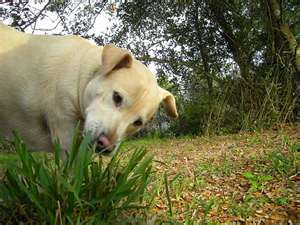
| Dogs Eating Grass |