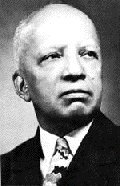
| Carter G. Woodson We owe our noble historians and writers a great deal of reverence for the contributions they have bestowed upon our Civilization. In today’s society whose focus centers on people of honor as being athletic or beautiful, we must not forget those who humbled themselves to gather the invaluable information of history and dedicated their lives to tell about it. Since February is the selected month to celebrate Black History Month, let us remember a great historian and writer who took the time to go beyond the ‘truth’ that was told in his day to uncover the many achievements of black people and bring them to the world’s attention. Again, his childhood story echo’s an all too familiar sound of many black Americans in his day who struggled against ideas of that era, poverty and the unavailability to obtain a formal education. Carter G. Woodson was determined to break the barriers to secure an education, defeat poverty, and change the way people thought of the African American culture. He made his mark by opening up a world full of promise for his people. Carter G. Woodson, (1875-1950), is widely regarded as the leading writer on black history of his time. He came from a large family whose parents were former slaves. Because of the need to work on the family farm, Woodson did not attend school regularly. He learned on his own until the age of 19 when he was able to enroll in the Frederick Douglass High School in Huntington, West Virginia. In less than two years, he secured his diploma and began teaching at his former high school, and for a short time served as principal. Woodson’s thirst for knowledge did not stop there. He taught school for the next 15 years while continuing graduate study. He earned B.A. and M.A. degrees from the University of Chicago, and a Ph.D. from Harvard University, the second African American to receive a doctorate from Harvard. He traveled abroad and studied in Asia and Europe, including a semester at the Sorbonne. His teaching and travels abroad gave him a mastery of several languages. In his career as an educator, he became convinced that among scholars the role of his own people in American history and in the history of other cultures was being either misrepresented or simply ignored. Dr. Woodson realized the need for special research into the neglected past of the Negro. Therefore, in 1915 he founded The Association for the Study of Negro Life and History. What Woodson is most noted for is not the numerous scholarly books he wrote on Black History, the organization of the Association for the Study of Negro Life and History, now the Association for the Study of Afro-American Life and History Inc., or the Associated Publishers, but the establishment of Negro History Week in 1926. Woodson chose the second week of February because two persons he felt had dramatically affected the lives of African Americans were born during that month: Frederick Douglass and Abraham Lincoln. The celebration of the achievements of African Americans later became established in 1976 as Black History Month. In conjunction with the commemoration of the nation’s Bicentennial, this observance was expanded to a month with the help of the Association for the Study of Afro- American Life and History. During this event, schools, libraries, museums, and other cultural agencies pay tribute to the African American presence in all fields of endeavor. The ASALH in Washington, D.C. sponsors Black History Month. Each year, the ASALH designates a theme. The theme for 2001 is “creating and defining the African American community: family, church, politics and culture “. Woodson devoted most of his life studying and writing about the African American experience. He investigated, researched, documented, published, and most of all preserved African American history. Woodson accomplished a lot in his lifetime and has been rightly given the title, “the father of black history.” Unfortunately, on April 3, 1950 Woodson died of a heart attack and was unable to realize his ambition of publishing the six volume Encyclopedia Africana. Nevertheless, the father of Black history was responsible for making Black studies an academically respected field of study. So it is during this time in February that we not only honor the great achievements of African Americans but also remember the man behind the history that is ours to embrace and pass on to generations to come. Works Cited: Photo courtesy of: http://members.aol.com/klove01/cgwodson.htm http://www.ai.mit.edu/~isbell/HFh/black/events_and_people/html/002.bhmonth.html http://www.gateway-va.com/pages/bhistory/1997/wood.htm http://www.worldbook.com/fun/aajourny/html/bh006.html http://www.artnoir.com/asalh/cgw.html http://www.afgen.com/woodson.html |