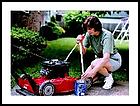
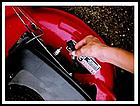
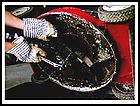
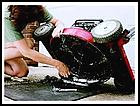
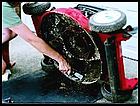
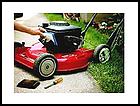
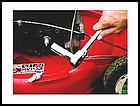
| This Old House Magazine: Putting Your Lawn Mower to Bed An end-of-season tune-up keeps power lawn equipment in shape By Scott Schilling, Photos by Kenneth Chen From This Old House Magazine Gas-powered lawn mowers and trimmers take their share of abuse during the warm months, so some care at the end of the season is vital to keeping their parts in good working condition. Replacing the oil, spark plugs, and air filters and applying a bit of elbow grease to grimy recesses before storing mowers for the winter will ensure that they rev up with a pull of the cord next year. Figure A Audrey Meinking, owner of Mineola Bicycle, Fitness, and Mower in Mineola, New York, demonstrates the proper servicing on a push mower; the same process also works for other small gas-powered machines such as trimmers and snowblowers. "If you don't take an hour or two for maintenance or bring your machines to a pro for servicing," she says, "there's a big chance you'll be stuck watching the grass grow come spring." 1. Empty the Gas Tank (figure A) Unused gas left in a mower over the winter can get stale, gumming up the carburetor and inviting rust. First, add fuel stabilizer to the tank, then run the mower to distribute it through the system. Turn the mower off and allow the engine to cool, then siphon excess gas into a clean can. (You can put this gas in your car, provided it hasn't been mixed with oil.) Restart the mower and run it until it stops; repeat until the engine no longer starts and the fuel lines are empty. Figure B 2. Disconnect the Spark Plug (figure B) Before continuing with the remaining maintenance steps, it's very important that you disconnect the spark plug to prevent the mower from kick-starting accidentally, which could lead to serious injury. Figure C 3. Remove the Blade (figure C) To make it easier to change the oil and clean the underside of the mower, first detach the blade by unscrewing the bolts that hold it in place. Be sure to wear thick gloves when handling the blade. While the blade is off, take advantage of the opportunity to sharpen it Figure D 4. Drain the Oil (figure D) If the mower has a 4-cycle engine, you'll need to change the oil. (Some mowers and most trimmers have 2-cycle engines, in which the oil is mixed with the gas.) Have a pan ready, and place a tarp under the mower to catch any oil that might spatter. Set the mower on its side with the air filter and carburetor facing up, so oil and residual gas don't spill into them. Remove the oil reservoir plug and slowly tilt the mower until the oil begins to drain into the pan. Replace the plug when all the oil has drained. Figure E 5. Clean the Undercarriage (figure E) Use a putty knife and wire brush to scrape off the grass and mud caked on the mower deck. This prevents rust, clears the passageway to the discharge chute, and allows the aerodynamics of the deck to work as designed. With the deck cleaned, reattach the sharpened blade. Once you've finished and can turn the mower upright, fill the oil tank with fresh SAE 30 or 30-weight oil, and recycle the used oil at a service station. Don't use a thicker oil, such as 10W-40. Figure F 6. Change the Air Filter (figure F) A dirty air filter keeps the engine from burning gas efficiently by restricting the air needed for combustion. If your mower has a paper filter, replace it with a new one, paper edges facing out. If it's an oil-soaked sponge filter, remove it, wash it out with soap and water, allow it to dry completely, and then add a bit of clean oil to it before putting it back. Clear the cooling fins of dirt and debris using a screwdriver or Popsicle stick. Figure G 7. Replace the Spark Plug (figure G) Remove and replace the spark plug, using a socket wrench with a spark-plug socket, which has a neoprene lining to protect the plug's porcelain casing. Even if the old spark plug is in good shape, for a couple of dollars a new one will perform better and ensure a smooth start come spring. ______________________________ The Cutting Edge A mower blade that has developed nicks, dings, and curls from hitting rocks and branches is no good to your lawn. A dull blade rips grass instead of cutting it cleanly, which leaves it more susceptible to disease. To sharpen a blade that's in fairly good condition, just clamp it in a vise every couple of weeks and run a metal file along the cutting edge, making sure to follow the angle of the factory bevel. (Always disconnect the spark-plug wire before taking off the blade or doing any mower maintenance.) If the blade is badly damaged, it needs to be sharpened on a bench grinder or may need to be replaced. A service shop can sharpen it for you or tell you when it's ready for the trash bin. But if you have your own grinder, it's easy to do the sharpening yourself. Begin by running the blade back and forth perpendicular to the spinning wheel to grind out nicks. This will give you a blunt but straight edge. Then hold the blade—supported by the rest plate—at the angle of the existing bevel and grind the length of the blade until you get a sharp edge. Finally, check to make sure the blade is balanced: An off-kilter blade can damage the mower. It's easy with a plastic balancer, available at lawn equipment shops and home centers for just a few dollars. Rest the blade on the balancer; if one side dips down, then you need to grind a bit of steel from that end (not from the cutting edge) to lighten it. Once the blade is balanced, bolt it back on the mower and you'll be ready to attack the long grass. |